Coffee to Water Ratio: The Simple Secret to a Better Cup
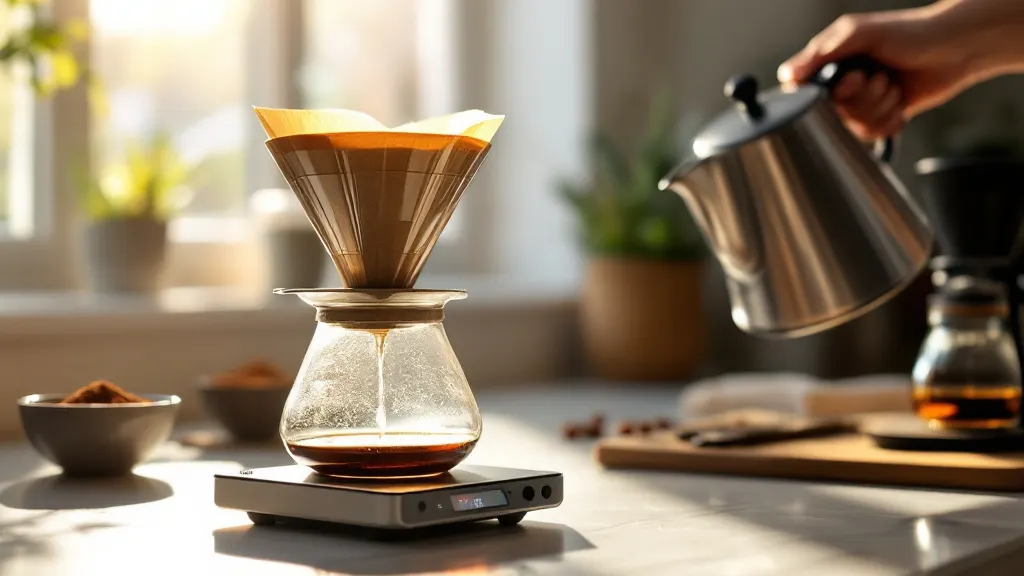
Short answer
A good coffee to water ratio for most brewing methods is 1:13 to 1:16 by weight, for example 15 g of coffee for 240 ml (8 fl oz) of water. French press ranges from 1:10 to 1:16, cold brew concentrate uses 1:4 to 1:5, and espresso uses about 1:2. In tablespoons, the classic guide is 1 to 2 tablespoons per 6 fl oz of water.
Barista tip
Run a tiny ratio experiment this weekend. Brew the same beans twice, once at 1:15 and once at 1:17, with everything else identical. Pour them into two matching mugs, sip each one blind and pick a winner. Write the winning ratio on a sticky note next to your coffee maker. That little note will make every future morning taste better.
The coffee to water ratio is the single easiest way to make your coffee taste better tomorrow morning. Get it right and the cup tastes sweet, round and full; get it wrong and it turns watery or harsh, even with great beans. The good news: you only need a few numbers. For most brewing methods, a ratio between 1:13 and 1:16 (1 g of coffee for every 13 to 16 g of water) is a happy place to start 1, 2.
What does a coffee to water ratio mean?
A ratio like 1:16 simply means 1 part coffee to 16 parts water, by weight. Because 1 ml of water weighs about 1 g, grams and milliliters of water are interchangeable for brewing. So:
- 15 g of coffee at 1:16 needs 240 g (240 ml, about 8 fl oz) of water.
- 20 g of coffee at 1:15 needs 300 g (300 ml, about 10 fl oz) of water.
- 60 g of coffee at 1:16 needs 960 g (960 ml, about 32 fl oz) of water.
A lower second number (1:12) means stronger coffee. A higher one (1:17) means lighter coffee. Use the calculator above to do the math for any cup or carafe.
What about tablespoons?
The National Coffee Association's classic "golden ratio" is 1 to 2 tablespoons of ground coffee for every 6 ounces (about 180 ml) of water 3. That works, but scoops are a little unpredictable: a tablespoon of fine, dark-roast coffee weighs differently than a tablespoon of coarse, light-roast coffee. If you can, weigh once with a kitchen scale, note how many scoops you used, and you will know your scoop forever.
Coffee to water ratio by brewing method
Each method extracts coffee differently, so each has its own sweet spot.
| Brewing method | Coffee : input water (espresso: beverage yield) | Grind | Water temperature | Contact time |
|---|---|---|---|---|
| Drip coffee maker | 1 to 2 tbsp per 6 fl oz 3 | medium, like kosher salt 3 | set by machine | about 5 min 3 |
| Pour-over | 1:13 to 1:16 1 | medium, adjust to taste 1 | 93 ± 3 °C (194 to 205 °F) 1 | 2 to 4 min 1 |
| French press | 1:10 to 1:16 2 | coarse, like rock salt 2 | 93 ± 3 °C (194 to 205 °F) 2 | about 4 min 2 |
| Cold brew concentrate | 1:4 to 1:5, then dilute 4 | coarse 4 | cold or room temperature | about 12 h 4 |
| Espresso | 1:2 5 | fine, like table salt 5 | nearly boiling, under pressure 5 | 20 to 30 s 5 |
These are official starting ranges from the National Coffee Association. They are wide on purpose, because taste is personal.
The best coffee ratio for each method
Drip coffee maker
Start in the middle of the range and adjust. In weight terms, many people land around 1:15 to 1:16, which sits inside the pour-over range 1. For a full 10-cup carafe, that means quite a lot of coffee, and that is fine: under-dosing is the most common reason drip coffee tastes thin. If you are shopping for a machine, our best drip coffee maker guide compares the options.
Pour-over
Pour-over loves precision. Try 1:16 for a light, tea-like cup or 1:14 for more body, with water just off the boil (93 ± 3 °C) and a total brew time of 2 to 4 minutes 1. A gooseneck kettle makes slow, even pouring much easier; see our best gooseneck kettle picks.
Hario V60 02 Dripper (Plastic)
pour-over cone $
Best for: learning pour-over, light, travel-friendly dripper
What we like
- Very low cost entry to pour-over
- Plastic body is light (about 200 g) and holds little heat
- Size 02 filters are sold almost everywhere
Keep in mind
- Fast flow rewards a gooseneck kettle and steady technique
- Needs cone-specific V60 paper filters
- type pour-over cone, spiral ribs, single large hole
- capacity 1-4 cups (size 02)
- material plastic (BPA-free)
- filter V60 02 conical paper filters
The Hario V60 02 is a low-cost cone that works with widely sold size 02 paper filters. Its fast flow rewards a steady pour.
French press
Immersion brewing is forgiving and rich. The NCA range runs from a punchy 1:10 to a lighter 1:16 2. A great everyday starting point is 1:15, steeped about 4 minutes with a coarse grind 2. For a 1-liter press, that is roughly 65 g of coffee.
Bodum Chambord French Press 8 cup
French press $
Best for: classic French press, full-bodied coffee for several people
What we like
- Iconic design sold for decades, spare glass beakers easy to find
- No paper filters needed
- Stainless steel frame and plunger
Keep in mind
- Mesh filter lets some fine sediment through
- Glass beaker can break; little heat retention
- type French press (immersion)
- capacity 1.0 l / 34 oz (8 cups of 4 oz)
- material borosilicate glass, stainless steel frame
- filter 3-part stainless steel mesh filter
The Bodum Chambord holds 1.0 liter (34 oz) and uses a stainless steel mesh filter, so no paper is needed 6. A note for cholesterol watchers: metal-filtered and boiled coffees let through coffee oils called cafestol and kahweol, which can raise LDL cholesterol, while paper filters hold them back 7, 8. If that matters to you, a paper-filter brewer is the gentler choice.
Cold brew
Cold brew is usually made as a concentrate at 1:4 to 1:5, steeped around 12 hours, then diluted with water or poured over ice 4. In a lab study of cold brew, caffeine and chlorogenic acid extraction reached equilibrium after about 6 to 7 hours, and medium roasts gave more of both than dark roasts 9. So an overnight steep is plenty, and you do not need to stretch it to a full day. A good place to start is diluting the concentrate 1:1 with water or milk, then adjusting to taste.
OXO Brew Compact Cold Brew Coffee Maker
cold brew $
Best for: small-batch cold brew, small fridges
What we like
- Compact footprint
- Makes concentrate that keeps about a week (brand guidance)
Keep in mind
- Smaller batch than full-size OXO Cold Brew maker
- Was shown out of stock on OXO's site
- type cold brew immersion
- capacity 24 oz brewing container (about 16 oz concentrate)
- material plastic brewer, glass carafe
- filter reusable stainless steel mesh filter (paper filters optional)
The OXO Brew Compact Cold Brew maker has a 24 oz brewing container that yields about 16 oz of concentrate, according to OXO 10.
Espresso
Espresso uses a much tighter ratio: about 1 g of coffee to 2 g of espresso, brewed in 20 to 30 seconds 5. Learn the full routine in how to make espresso.
Quick cheat sheet: how much coffee for your batch
Here is the math done for you at two popular ratios. Water is given in milliliters and US fluid ounces; coffee is rounded to the nearest gram.
| Water | Coffee at 1:15 (stronger) | Coffee at 1:16 (balanced) |
|---|---|---|
| 240 ml (8 fl oz), one mug | 16 g | 15 g |
| 350 ml (12 fl oz), a big mug | 23 g | 22 g |
| 500 ml (17 fl oz), two cups | 33 g | 31 g |
| 1,000 ml (34 fl oz), a full French press | 67 g | 63 g |
| 1,500 ml (51 fl oz), a large drip carafe | 100 g | 94 g |
Remember that the wet coffee grounds hold on to some of the water, so the coffee in your cup is a little less than the water you poured. That is why many people brew slightly more than their mug holds.
Beyond the ratio: water, beans and roast
The ratio sets the strength, but three other things shape the flavor:
- Water. Coffee is mostly water, so if your tap water tastes of chlorine, your coffee will too. Filtered water that tastes clean and fresh is a simple upgrade. Very soft or distilled water tends to taste flat, and very hard water can leave scale in your machine.
- Temperature. For pour-over and French press, the NCA suggests water around 93 °C (199 °F), give or take 3 °C 1, 2. If you have no thermometer, let boiled water rest for about 30 seconds.
- Beans and roast. Light roasts are denser and often taste best a touch stronger or ground a little finer; dark roasts extract easily and can taste bitter at strong ratios. Our guide to light roast vs dark roast explains why, and the best coffee beans guide helps you choose.
AeroPress and moka pot
These two do not have official NCA ranges, so treat them as playgrounds. The AeroPress handles anything from a strong concentrate you top up with water to a regular-strength cup. A moka pot is simpler: fill the basket level without tamping and fill the water to just below the valve, and the pot sets its own ratio. Explore more brewers in our coffee makers hub.
How to fix your coffee with the ratio
Taste first, then adjust one thing at a time:
- Too weak or watery: use more coffee (go from 1:17 to 1:15). If it is also sour, grind a little finer.
- Too strong or heavy: use less coffee (go from 1:14 to 1:16).
- Bitter and harsh: the ratio may be fine, but the grind could be too fine or the brew too long. Grind a bit coarser.
- Sour and thin: grind finer or brew a little longer, and check that your water is hot enough.
Strength (how concentrated the cup is) mostly follows the ratio. Flavor balance (sour vs bitter) mostly follows grind and time. Keep those two ideas separate and dialing in gets easy. Our coffee grind size chart shows which grind fits which brewer.
Why a coffee scale beats scoops
A simple kitchen scale turns your favorite cup into a repeatable recipe. Weigh the beans, tare, weigh the water as you pour, and you will get the same lovely cup every day. A built-in timer helps with pour-over and espresso.
Hario V60 Drip Scale
pour-over scale with timer $
Best for: first scale for V60 brewers
What we like
- Integrated timer
- Slim footprint
Keep in mind
- Uses AAA batteries
- Resolution coarser at higher weights
- max g 2000
- resolution g 0.1 to 200 g; coarser above (retailer)
- timer ✓
- battery 2x AAA
- dimensions cm 12 x 19 x 2.9
The Hario V60 Drip Scale combines a scale and a timer in a slim body 11. Explore more options in our best coffee scale guide.
Does the ratio change caffeine?
Yes, roughly. More coffee per cup extracts more caffeine into that cup. As a reference, USDA data put an 8 fl oz (about 240 ml) cup of brewed coffee at roughly 95 mg of caffeine 12. A stronger ratio or a bigger mug pushes that up, and cold brew concentrate is very strong until you dilute it. If you are counting, plan your day with our free planner.
When to talk to a doctor
If you are watching your cholesterol, paper-filtered coffee is the gentler choice than French press or boiled coffee; ask your doctor what suits you.
Frequently asked questions
What is the golden ratio for coffee?
The National Coffee Association calls 1 to 2 tablespoons of ground coffee per 6 fl oz (about 180 ml) of water the golden ratio for drip coffee [3]. By weight, a ratio between 1:13 and 1:16 covers most pour-over and filter brewing [1]. Start around 1:15 or 1:16, then adjust stronger or lighter to taste.
How much coffee do I need for 12 cups?
It depends on how big your machine's cups are, since many coffee makers count a cup as 5 or 6 fl oz rather than 8. For 60 fl oz (about 1.8 liters) of water at 1:16, you need about 110 g of coffee; at 1:15, about 120 g. Using the tablespoon guide, that is 10 to 20 tablespoons [3].
What is the best coffee to water ratio for French press?
The NCA range for French press is 1:10 to 1:16, with a coarse grind, water around 93 °C (199 °F) and about 4 minutes of steeping [2]. A friendly everyday starting point is 1:15, roughly 65 g of coffee for a 1-liter press. Go toward 1:12 for a bolder, heavier cup.
What ratio should I use for cold brew?
For concentrate, the NCA suggests 1:4 to 1:5 coffee to water with a coarse grind and about 12 hours of steeping [4]. Dilute it with water, milk or ice before drinking. A lab study found caffeine extraction in cold brew levels off after about 6 to 7 hours, so overnight steeping is enough [9].
Is it better to measure coffee by weight or by scoop?
Weight is more reliable. A scoop of coarse, light-roast coffee weighs differently than the same scoop of fine, dark-roast coffee, so the strength of your cup can drift from day to day. A simple kitchen scale with 0.1 g resolution makes your recipe repeatable. If you prefer scoops, weigh once to learn what your scoop holds.
Sources
We link to the original studies and official pages so you can check every claim.
- National Coffee Association USA (2026). Pour-over coffee - About Coffee. About Coffee (NCA).
- National Coffee Association USA (2026). French press coffee - About Coffee. About Coffee (NCA).
- National Coffee Association USA (2026). Drip coffee - About Coffee. About Coffee (NCA).
- National Coffee Association USA (2026). Cold brew coffee - About Coffee. About Coffee (NCA).
- National Coffee Association USA (2026). Espresso - About Coffee. About Coffee (NCA).
- Bodum (2026). Chambord French Press 8 cup. Bodum.
- Urgert R, Katan MB (1997). The cholesterol-raising factor from coffee beans. Annu Rev Nutr.
- Gross G, Jaccaud E, Huggett AC (1997). Analysis of the content of the diterpenes cafestol and kahweol in coffee brews. Food Chem Toxicol.
- Fuller M, Rao NZ (2017). The Effect of Time, Roasting Temperature, and Grind Size on Caffeine and Chlorogenic Acid Concentrations in Cold Brew Coffee. Sci Rep.
- OXO (2026). Brew Compact Cold Brew Coffee Maker. OXO.
- Hario (2026). V60 Drip Scale (VSTN-2000B). Hario.
- USDA Agricultural Research Service. Beverages, coffee, brewed, prepared with tap water (FDC ID 171890, SR Legacy). USDA FoodData Central.

About the author
Petr Hess, Founder, chemical engineer. Petr Hess studied chemical engineering and loves exploring how substances act on the human body. Coffee is his favorite of them: he reads the studies on caffeine, enzymes and digestion, compares the spec sheets of machines and grinders, and brews more coffee than is strictly reasonable, so you can choose well and enjoy every cup. How we choose.
Keep reading
 Coffee worldWhich Country Drinks the Most Coffee? A Cheerful World Tour of the NumbersFinland drinks the most coffee per person, about 12 kg a year in StoneX's 2023 ranking, followed by Norway, Iceland and Denmark.
 Coffee worldCoffee Culture Around the World: Inside the 5 Coffee SuperpowersCoffee culture differs hugely among these five major coffee nations.
 Coffee makersNespresso vs Keurig: Espresso Charm or Classic Mug Comfort?In the Nespresso vs Keurig choice, pick Nespresso if you love espresso, cappuccinos and crema, or a Vertuo machine if you want espresso and mugs from one machine.
 Beans & subscriptionsThe Best Coffee Subscriptions for Fresh, Happy Mornings at HomeThe best coffee subscription for most people is Trade, which uses a short taste quiz to match you with coffees from more than 55 US roasters and lets you adjust or pause deliveries.